
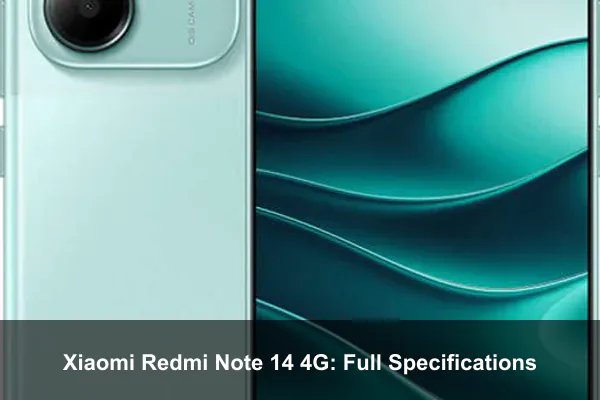
Xiaomi Redmi Note 14 4G is built for buyers who want a modern display and dependable battery life without stretching into higher 5G price tiers.
Instead of repeating the full spec table, this guide focuses on ownership value: where the phone over-delivers, where it cuts back, and who it fits best.
Full Specifications
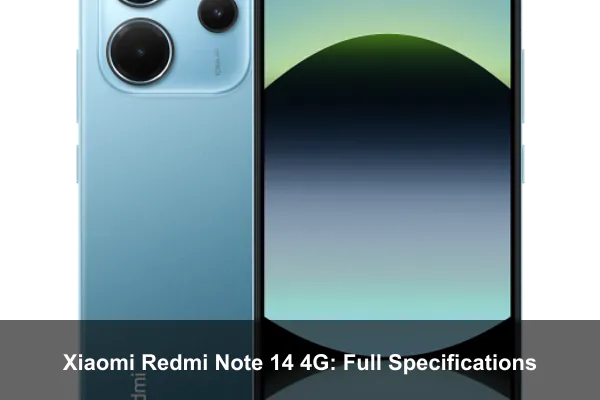
Network
| Technology: | GSM / HSPA / LTE |
| 2G bands: | GSM 850 / 900 / 1800 / 1900 |
| 3G bands: | HSDPA 850 / 900 / 2100 |
| 4G bands: | 1, 3, 5, 7, 8, 20, 28, 38, 40, 41 |
| Speed: | HSPA, LTE |
Launch
| Announced: | 2025, January 10 |
| Status: | Available. Released 2025, January 15 |
Body
| Dimensions: | 163.3 x 76.6 x 8.2 mm (6.43 x 3.02 x 0.32 in) |
| Weight: | 196.5 g (6.95 oz) |
| Build: | Glass front (Gorilla Glass 5), plastic back, aluminum frame |
| SIM: | Nano-SIM + Nano-SIM |
| IP54 dust protected and water resistant (water splashes) |
Display
| Type: | AMOLED, 120Hz, 960Hz PWM, 1200 nits (HBM), 1800 nits (peak) |
| Size: | 6.67 inches, 107.4 cm2 (~85.9% screen-to-body ratio) |
| Resolution: | 1080 x 2400 pixels, 20:9 ratio (~395 ppi density) |
| Protection: | Corning Gorilla Glass 5, Mohs level 5 |
Platform
| OS: | Android 14, up to 4 major Android upgrades, HyperOS |
| Chipset: | Mediatek Helio G99 Ultra (6 nm) |
| CPU: | Octa-core (2×2.2 GHz Cortex-A76 & 6×2.0 GHz Cortex-A55) |
| GPU: | Mali-G57 MC2 |
Memory
| Card slot: | microSDXC (uses shared SIM slot) |
| Internal: | 128GB 6GB RAM, 128GB 8GB RAM, 256GB 6GB RAM, 256GB 8GB RAM |
| UFS 2.2 |
Main Camera
| Triple: | 108 MP, f/1.7, (wide), 1/1.67″, 0.64µm, PDAF 2 MP, f/2.4, (macro) 2 MP, f/2.4, (depth) |
| Features: | LED flash, HDR, panorama |
| Video: | 1080p@30/60fps |
Selfie camera
| Single: | 20 MP, f/2.2, (wide), 1/4.0″, 0.7µm |
| Video: | 1080p@30fps |
Sound
| Loudspeaker: | Yes, with stereo speakers (with Dolby Atmos) |
| 3.5mm jack: | Yes |
Comms
| WLAN: | Wi-Fi 802.11 a/b/g/n/ac, dual-band, Wi-Fi Direct |
| Bluetooth: | 5.3, A2DP, LE |
| Positioning: | GPS, GLONASS, BDS, GALILEO |
| NFC: | Yes (market/region dependent) |
| Infrared port: | Yes |
| Radio: | Unspecified |
| USB: | USB Type-C 2.0, OTG |
Features
| Sensors: | Fingerprint (under display, optical), accelerometer, gyro, compass, proximity |
Battery
| Type: | 5500 mAh |
| Charging: | 33W wired, 55% in 44 min |
Misc
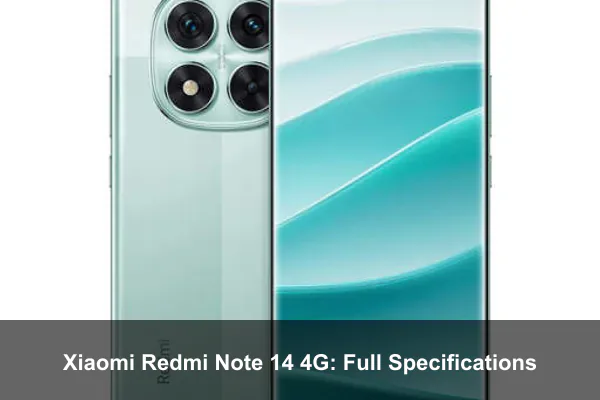
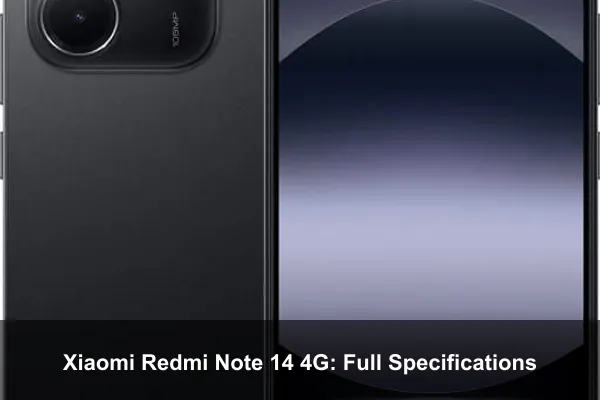
| Colors: | Midnight Black, Mist Purple, Ocean Blue, Lime Green |
| Models: | 24117RN76G, 24117RN76O, 24117RN76E |
| SAR EU: | 1.00 W/kg (head) 0.97 W/kg (body) |
| Price: | € 120.00 / $ 175.00 / £ 117.90 |
Our Tests
| Loudspeaker: | -24.8 LUFS (Very good) |
| Battery: | Active use score 12:47h |
EU LABEL
| Energy: | Class B |
| Battery: | 48:49h endurance, 1600 cycles |
| Free fall: | Class D (45 falls) |
| Repairability: | Class C |
Price and Availability
The Xiaomi Redmi Note 14 4G offers a compelling combination of features and performance. While the base price is around €120, the actual cost may vary depending on your location and retailer. Below, you’ll find the approximate price of the Xiaomi Redmi Note 14 4G converted into various currencies. Please note that these are estimates based on recent exchange rates as of March 23, 2026 and may not reflect the exact price you’ll find at a retailer.
- United States: $139
- Japan: ¥22,071
- United Kingdom: £104
- Australia: A$197
- Canada: C$190
- Taiwan: NT$4,432
- Denmark: kr895
- Saudi Arabia: ﷼520
- South Korea: ₩208,420
- Germany: €120
- Brazil: R$734
- Vietnam: ₫3.629.795
- Kenya: KSh 17,923
- India: ₹12,990
- Indonesia: Rp 2.353.048
- Nigeria: ₦187,939
- Pakistan: ₨38,664
- Philippines: ₱8,303
- Bangladesh: ৳১৭,০০২
Value Positioning in 2025 Budget Phones
The Redmi Note 14 4G is priced to compete aggressively while still offering features many entry phones skip, including a 120Hz AMOLED panel, stereo speakers with Dolby Atmos, a 3.5mm jack, and an infrared blaster. For buyers comparing spec sheets in the low-cost segment, this is a strong feature-to-price balance.
Design and Build Quality
Xiaomi uses a practical mix of materials: Gorilla Glass 5 on the front, an aluminum frame, and a plastic back to control cost and weight. IP54 splash resistance adds daily-use confidence, while the shared microSD/SIM tray means users must choose between dual-SIM flexibility and expandable storage.
Display Quality for Daily Use
The 6.67-inch AMOLED display is a standout at this level. The 120Hz refresh rate improves scrolling smoothness, while high brightness support helps outdoor visibility. A 960Hz PWM implementation is also notable for users sensitive to display flicker during long sessions.
Performance: Reliable, Not Flagship Fast
With the Helio G99 Ultra and UFS 2.2 storage, day-to-day performance is consistent for messaging, social apps, browsing, and light-to-mid gaming. Compared with newer 5G-focused chips, it is less future-proof for demanding games, but it remains efficient and stable for mainstream workloads.
Camera System: Main Sensor Does the Heavy Lifting
The 108MP main camera is the clear focus and should deliver the best results in good lighting. The macro and depth sensors are more support cameras than core upgrades, so this is not a versatility-first camera phone. Video topping out at 1080p also positions it as practical rather than creator-focused.
Battery Endurance and Charging Practicality
A 5500mAh battery gives the phone strong runtime, backed by a tested active-use score of 12:47 hours. Charging is 33W, with 55% in 44 minutes, which is solid though not class-leading. EU label data also supports longevity expectations, citing 1600 battery cycles and 48:49h endurance.
Software Support and Long-Term Ownership
Android 14 with HyperOS and up to four major Android upgrades is a major value point. In this price class, software policy can matter more than raw benchmark numbers, and Xiaomi gives this model a clearer long-term path than many direct budget rivals.
Connectivity and Useful Extras
For a 4G phone, connectivity is well-rounded: broad LTE band support, dual-band Wi-Fi ac, Bluetooth 5.3, multi-system positioning, and USB-C with OTG. NFC availability depends on region, but stereo audio, headphone jack support, and IR control add practical everyday utility.
Who Should Buy the Redmi Note 14 4G?
This phone makes the most sense for budget-focused users who prioritize display quality, battery life, and long software support over 5G and advanced camera flexibility. If you need top gaming power, faster charging, or a more versatile multi-camera setup, stepping up to a higher tier will be the better move.
Conclusion
Xiaomi Redmi Note 14 4G is a value-first package with a strong screen, dependable endurance, and better-than-expected software longevity for the price. It is a clear recommendation for cost-conscious users who are comfortable staying on 4G.
