
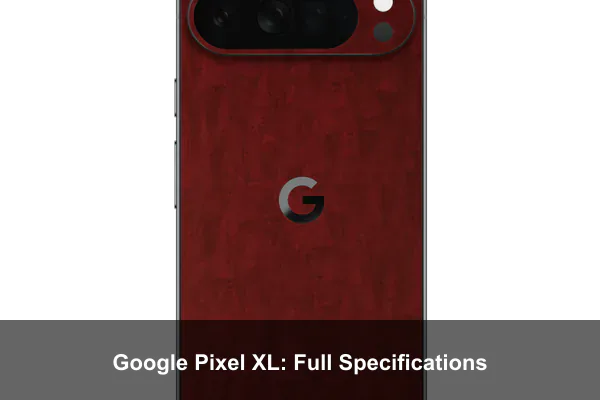
The Google Pixel XL is a discontinued 2016 flagship that still gets attention for its sharp AMOLED panel, capable camera hardware, and practical essentials like a headphone jack.
This article takes a legacy-buyer angle: instead of repeating the full table, it focuses on how Pixel XL fits against newer budget phones in real-world use.
Full Specifications
Network
| Technology | GSM / HSPA / LTE |
| 2G bands | GSM 850 / 900 / 1800 / 1900 |
| HSDPA 800 / 850 / 900 / 1700(AWS) / 1900 / 2100 | |
| 4G bands | 1, 2, 3, 4, 5, 7, 8, 12, 13, 17, 18, 19, 20, 21, 26, 28, 32, 38, 39, 40, 41 |
| Speed | HSPA 42.2/5.76 Mbps, LTE (3CA) Cat9 450/50 Mbps or LTE (3CA) Cat11 600/75 Mbps |
| GPRS | Yes |
| EDGE | Yes |
Launch
| Announced | 2016, October 04. Released 2016, October 20 |
| Status | Discontinued |
Body
| Dimensions | 154.7 x 75.7 x 8.5 mm (6.09 x 2.98 x 0.33 in) |
| Weight | 168 g (5.93 oz) |
| Build | Glass front (Gorilla Glass 4), aluminum/glass back, aluminum frame |
| SIM | Nano-SIM |
| Water-repellent coating |
Display
| Type | AMOLED |
| Size | 5.5 inches, 83.4 cm2 (~71.2% screen-to-body ratio) |
| Resolution | 1440 x 2560 pixels, 16:9 ratio (~534 ppi density) |
| Protection | Corning Gorilla Glass 4 |
Platform
| OS | Android 7.1 (Nougat), upgradable to Android 10 |
| Chipset | Qualcomm MSM8996 Snapdragon 821 (14 nm) |
| CPU | Quad-core (2×2.15 GHz Kryo & 2×1.6 GHz Kryo) |
| GPU | Adreno 530 |
Memory
| Card slot | No |
| Internal | 32GB 4GB RAM, 128GB 4GB RAM |
| UFS 2.0 |
Main Camera
| Single | 12.3 MP, f/2.0, 1/2.3", 1.55µm, PDAF |
| Features | Laser AF, Dual-LED flash, HDR, panorama |
| Video | 4K@30fps, 1080p@60/120fps, 1080p@30fps (gyro-EIS), 720p@240fps |
Selfie camera
| Single | 8 MP, f/2.4, 1/3.2", 1.4µm |
| Video | 1080p@30fps |
Sound
| Loudspeaker | Yes |
| 3.5mm jack | Yes |
Comms
| WLAN | Wi-Fi 802.11 a/b/g/n/ac, dual-band, Wi-Fi Direct, DLNA |
| Bluetooth | 4.2, A2DP, LE, aptX |
| Positioning | GPS, GLONASS |
| NFC | Yes |
| Radio | No |
| USB | USB Type-C 3.0 |
Features
| Sensors | Fingerprint (rear-mounted), accelerometer, gyro, proximity, compass, barometer |
Battery
| Type | Li-Ion 3450 mAh, non-removable |
| Charging | 18W wired, PD |
| Stand-by | Up to 552 h (3G) |
| Talk time | Up to 32 h (3G) |
| Music play | Up to 130 h |
Misc
| Colors | Quite Black, Very Silver, Really Blue |
| SAR | 0.89 W/kg (head) 0.56 W/kg (body) |
| SAR EU | 0.25 W/kg (head) 0.44 W/kg (body) |
| Price | About 400 EUR |
Our Tests
| Performance | Basemark OS II 2.0: 2281Basemark X: 30861 |
| Display | Contrast ratio: Infinite (nominal), 4.164 (sunlight) |
| Camera | Photo / Video |
| Battery (old) | Endurance rating 78h |
Price and Availability
The Google Pixel XL offers a compelling combination of features and performance. While the base price is around €400, the actual cost may vary depending on your location and retailer. Below, you’ll find the approximate price of the Google Pixel XL converted into various currencies. Please note that these are estimates based on recent exchange rates as of March 23, 2026 and may not reflect the exact price you’ll find at a retailer.
- United States: $462
- Japan: ¥73,571
- United Kingdom: £347
- Australia: A$658
- Canada: C$634
- Taiwan: NT$14,774
- Denmark: kr2.984
- Saudi Arabia: ﷼1,734
- South Korea: ₩694,733
- Germany: €400
- Brazil: R$2.447
- Vietnam: ₫12.099.315
- Kenya: KSh 59,744
- India: ₹43,301
- Indonesia: Rp 7.843.494
- Nigeria: ₦626,464
- Pakistan: ₨128,881
- Philippines: ₱27,675
- Bangladesh: ৳৫৬,৬৭৫
Value in 2026
As an older flagship listed at about 400 EUR in the source data, the Pixel XL is strongest as a low-cost secondary device. Compared with many newer entry phones, it can still feel premium in display quality, but software age is the main compromise.
Design and Build Quality
The combination of Gorilla Glass 4 front, aluminum frame, and aluminum/glass back still feels solid. Its 5.5-inch body and 168 g weight are relatively manageable by today’s standards, and the water-repellent coating adds everyday practicality.
Display Experience
The 1440p AMOLED panel with roughly 534 ppi remains a highlight for text clarity and media detail. Test notes showing infinite nominal contrast support its visual strength, although modern phones generally offer better outdoor brightness.
Performance for Daily Tasks
Snapdragon 821 with 4 GB RAM and UFS 2.0 keeps basic apps and navigation usable, but demanding multitasking and newer games can show clear limits. No microSD slot means storage choice matters from the start.
Camera Strengths and Limits
The 12.3 MP main camera uses large pixels, PDAF, and laser AF, with 4K30 and high-frame-rate video options. It still performs reliably in good light, while newer devices usually pull ahead in low-light processing and advanced zoom flexibility.
Battery and Charging
A 3450 mAh battery with 18W PD charging remains practical for moderate daily use, and older endurance testing rated it at 78 hours. Because this is a 2016 device, actual battery life now depends heavily on battery condition.
Software and Longevity
The device launched on Android 7.1 and tops out at Android 10. That update ceiling is the biggest buying risk today, especially for users who prioritize long-term security and broad app compatibility.
Connectivity and Everyday Features
Pixel XL still covers key essentials with broad LTE support, dual-band Wi-Fi ac, Bluetooth 4.2 with aptX, NFC, USB-C 3.0, GPS/GLONASS, and a 3.5 mm jack. The obvious limitation for modern buyers is the lack of 5G.
Who Should Buy Google Pixel XL
This phone fits collectors, Android enthusiasts, and buyers needing a backup handset with a sharp screen and dependable core camera behavior. Users wanting a primary phone with current software support and stronger long-term performance should choose a newer model.
Conclusion
Google Pixel XL remains a well-built legacy flagship with excellent screen sharpness and a still-capable camera base, but its Android 10 ceiling is a major limitation. Recommendation: buy only at a clearly low price if you accept the software-age tradeoff.
