
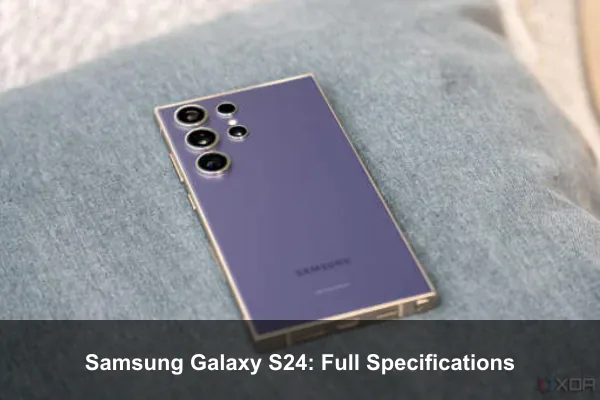
The Samsung Galaxy S24 targets buyers who want true flagship features without moving to a big, heavy phone. It combines a compact 6.2-inch form factor with premium build quality and broad global 5G support.
Instead of repeating the full spec sheet, this overview focuses on buying value: regional chipset differences, real-world test data, and where the S24 still stands out against similarly priced rivals.
Full Specifications
Network
| Technology: | GSM / CDMA / HSPA / EVDO / LTE / 5G |
| 2G bands: | GSM 850 / 900 / 1800 / 1900 |
| CDMA 800 / 1900 & TD-SCDMA | |
| 3G bands: | HSDPA 850 / 900 / 1700(AWS) / 1900 / 2100 |
| CDMA2000 1xEV-DO | |
| 4G bands: | 1, 2, 3, 4, 5, 7, 8, 12, 13, 17, 18, 19, 20, 25, 26, 28, 32, 38, 39, 40, 41, 66 – International |
| 1, 2, 3, 4, 5, 7, 8, 12, 13, 14, 18, 19, 20, 25, 26, 28, 29, 30, 38, 39, 40, 41, 48, 66, 71 – USA | |
| 5G bands: | 1, 2, 3, 5, 7, 8, 12, 20, 25, 26, 28, 38, 40, 41, 66, 75, 77, 78 SA/NSA/Sub6 – International |
| 1, 7, 25, 28, 41, 66, 71, 78, 257, 258, 260, 261 SA/NSA/Sub6/mmWave – USA | |
| Speed: | HSPA, LTE (up to 7CA), 5G |
Launch
| Announced: | 2024, January 17 |
| Status: | Available. Released 2024, January 24 |
Body
| Dimensions: | 147 x 70.6 x 7.6 mm (5.79 x 2.78 x 0.30 in) |
| Weight: | 167 g or 168 g (5.89 oz) |
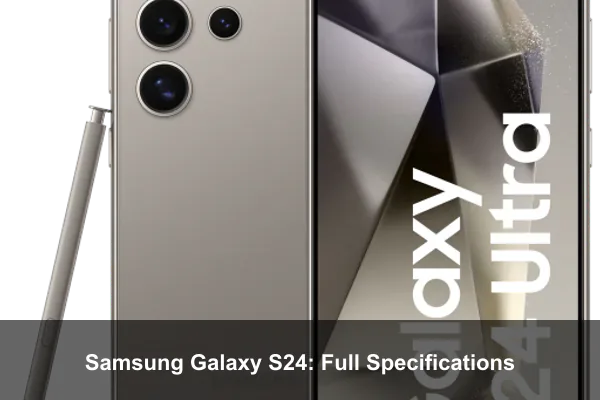
| Build: | Glass front (Gorilla Glass Victus 2), glass back (Gorilla Glass Victus 2), aluminum frame |
| SIM: | Nano-SIM + Nano-SIM + eSIM + eSIM (max 2 at a time) – INT Nano-SIM + eSIM + eSIM (max 2 at a time) – USA Nano-SIM + Nano-SIM – CN |
| IP68 dust tight and water resistant (immersible up to 1.5m for 30 min) Armor aluminum 2 frame |
Display
| Type: | Dynamic LTPO AMOLED 2X, 120Hz, 480Hz PWM, HDR10+, 2600 nits (peak) |
| Size: | 6.2 inches, 94.4 cm2 (~90.9% screen-to-body ratio) |
| Resolution: | 1080 x 2340 pixels, 19.5:9 ratio (~416 ppi density) |
| Protection: | Corning Gorilla Glass Victus 2 |
Platform
| OS: | Android 14, up to 7 major Android upgrades, One UI 6.1.1 |
| Chipset: | Qualcomm SM8650-AC Snapdragon 8 Gen 3 (4 nm) – USA/Canada/ChinaExynos 2400 (4 nm) – International |
| CPU: | 8-core (1×3.39GHz Cortex-X4 & 3×3.1GHz Cortex-A720 & 2×2.9GHz Cortex-A720 & 2×2.2GHz Cortex-A520)10-core (1×3.2GHz Cortex-X4 & 2×2.9GHz Cortex-A720 & 3×2.6GHz Cortex-A720 & 4×1.95GHz Cortex-A520) |
| GPU: | Adreno 750 (1 GHz) – USA/Canada/ChinaXclipse 940 – International |
Memory
| Card slot: | No |
| Internal: | 128GB 8GB RAM, 256GB 8GB RAM, 256GB 12GB RAM, 512GB 8GB RAM |
| UFS 3.1 – 128GB only UFS 4.0 |
Main Camera
| Triple: | 50 MP, f/1.8, 24mm (wide), 1/1.56″, 1.0µm, dual pixel PDAF, OIS 10 MP, f/2.4, 67mm (telephoto), 1/3.94″, 1.0µm, PDAF, OIS, 3x optical zoom 12 MP, f/2.2, 13mm, 120˚ (ultrawide), 1/2.55″ 1.4µm, Super Steady video |
| Features: | LED flash, auto-HDR, panorama |
| Video: | 8K@24/30fps, 4K@30/60fps, 1080p@30/60/120/240fps, HDR10+, stereo sound rec., gyro-EIS |
Selfie camera
| Single: | 12 MP, f/2.2, 26mm (wide), 1/3.2″, 1.12µm, dual pixel PDAF |
| Features: | HDR, HDR10+ |
| Video: | 4K@30/60fps, 1080p@30fps |
Sound
| Loudspeaker: | Yes, with stereo speakers |
| 3.5mm jack: | No |
| 32-bit/384kHz audio Tuned by AKG |
Comms
| WLAN: | Wi-Fi 802.11 a/b/g/n/ac/6e, tri-band, Wi-Fi Direct |
| Bluetooth: | 5.3, A2DP, LE |
| Positioning: | GPS, GLONASS, BDS, GALILEO, QZSS |
| NFC: | Yes |
| Radio: | No |
| USB: | USB Type-C 3.2, DisplayPort 1.2, OTG |
Features
| Sensors: | Fingerprint (under display, ultrasonic), accelerometer, gyro, proximity, compass, barometer |
| Samsung DeX, Samsung Wireless DeX (desktop experience support) Circle to Search |
Battery
| Type: | Li-Ion 4000 mAh |
| Charging: | 25W wired, PD3.0, 50% in 30 min 15W wireless (Qi) 4.5W reverse wireless |
Misc
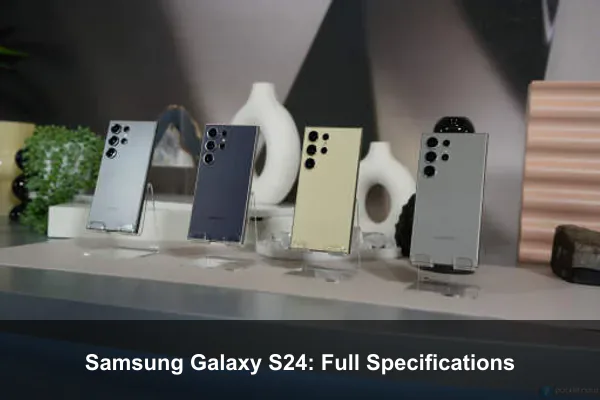
| Colors: | Onyx Black, Marble Grey, Cobalt Violet, Amber Yellow, Jade Green, Sandstone Orange, Sapphire Blue |
| Models: | SM-S921B, SM-S921B/DS, SM-S921U, SM-S921U1, SM-S921W, SM-S921N, SM-S9210, SM-S921E, SM-S921E/DS |
| SAR: | 1.23 W/kg (head) 1.10 W/kg (body) |
| SAR EU: | 0.87 W/kg (head) 1.35 W/kg (body) |
| Price: | € 458.00 / $ 328.70 / £ 348.99 / ₹ 42,761 |
Our Tests
| Performance: | AnTuTu: 1218977 (v9), 1696727 (v10) GeekBench: 5833 (v5), 6747 (v6) 3DMark: 4183 (Wild Life Extreme) |
| Display: | 1401 nits max brightness (measured) |
| Camera: | Photo / Video |
| Loudspeaker: | -25.2 LUFS (Very good) |
| Battery: | Active use score 12:06h |
Price and Availability
The Samsung Galaxy S24 offers a compelling combination of features and performance. While the base price is around €458, the actual cost may vary depending on your location and retailer. Below, you’ll find the approximate price of the Samsung Galaxy S24 converted into various currencies. Please note that these are estimates based on recent exchange rates as of March 23, 2026 and may not reflect the exact price you’ll find at a retailer.
- United States: $529
- Japan: ¥84,239
- United Kingdom: £397
- Australia: A$754
- Canada: C$726
- Taiwan: NT$16,916
- Denmark: kr3.417
- Saudi Arabia: ﷼1,985
- South Korea: ₩795,469
- Germany: €458
- Brazil: R$2.801
- Vietnam: ₫13.853.716
- Kenya: KSh 68,407
- India: ₹49,580
- Indonesia: Rp 8.980.800
- Nigeria: ₦717,301
- Pakistan: ₨147,569
- Philippines: ₱31,688
- Bangladesh: ৳৬৪,৮৯৩
Value in the Current Market
At the listed price range, the Galaxy S24 offers a rare mix of compact size, IP68 durability, telephoto zoom, and premium ecosystem features like Samsung DeX. Many similarly priced alternatives deliver bigger batteries or faster charging, but often skip this level of overall balance.
Design and Build Quality
With a 147 x 70.6 x 7.6 mm body and 167-168 g weight, the S24 is one of the easiest flagship phones to use one-handed. Gorilla Glass Victus 2 on both sides, an Armor Aluminum 2 frame, and IP68 protection make it feel high-end and travel-friendly.
Display Quality
The 6.2-inch Dynamic LTPO AMOLED 2X panel combines 120Hz refresh, HDR10+, and up to 2600 nits peak brightness. Measured max brightness at 1401 nits confirms strong outdoor readability, while the flat FHD+ panel remains sharp at around 416 ppi.
Performance and Regional Variants
Performance depends on region: Snapdragon 8 Gen 3 (USA/Canada/China) or Exynos 2400 (International). Benchmark results are strong for class, including AnTuTu v10 at 1,696,727, Geekbench 6 at 6,747, and 3DMark Wild Life Extreme at 4,183. Storage configuration matters too, since the 128GB model uses UFS 3.1 while higher tiers move to faster UFS 4.0.
Camera System in Practical Use
The triple camera setup remains versatile: a 50MP main sensor with OIS, a 10MP 3x telephoto with OIS, and a 12MP ultrawide. This gives the S24 an edge over phones that rely only on digital zoom. Video support is also flagship-grade with up to 8K recording, HDR10+, and gyro-EIS, while the 12MP selfie camera supports 4K60.
Battery Life and Charging Trade-Offs
The 4000 mAh battery posts an active use score of 12:06h, which is solid for a compact flagship. Charging is functional rather than aggressive: 25W wired, 15W wireless, and 4.5W reverse wireless. Buyers focused on ultra-fast top-ups may find this conservative, but day-to-day endurance is dependable.
Software and Long-Term Ownership
Samsung ships Android 14 with One UI 6.1.1 and promises up to 7 major Android upgrades, giving the S24 excellent long-term value. Features like Circle to Search, Samsung DeX, and Wireless DeX add practical productivity options that many rivals still do not match.
Connectivity and Network Flexibility
Connectivity is a major strength: extensive 4G and 5G band support, including mmWave in the USA variant, plus Wi-Fi 6E, Bluetooth 5.3, NFC, and USB-C 3.2 with DisplayPort 1.2. SIM support also varies by market, so frequent travelers should check local model numbers before purchase.
Who Should Buy the Galaxy S24
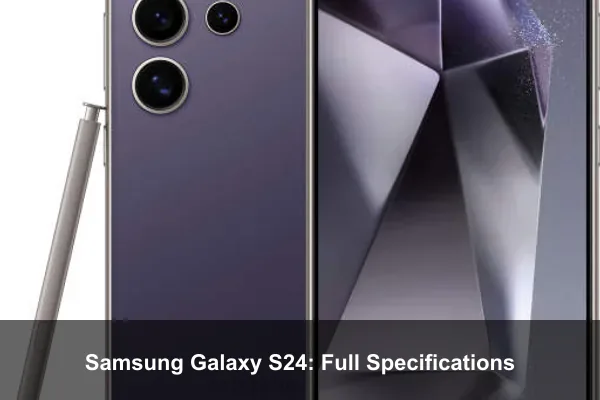
This phone fits users who want a compact flagship that does not sacrifice camera flexibility, software support, or premium build quality. It is especially suitable for buyers who keep phones for years and value stable all-round performance over headline charging speeds.
Conclusion
The Galaxy S24 remains a strong compact flagship choice if you prioritize long software support, reliable cameras, and top-tier connectivity; just pick the right regional and storage variant before buying.
