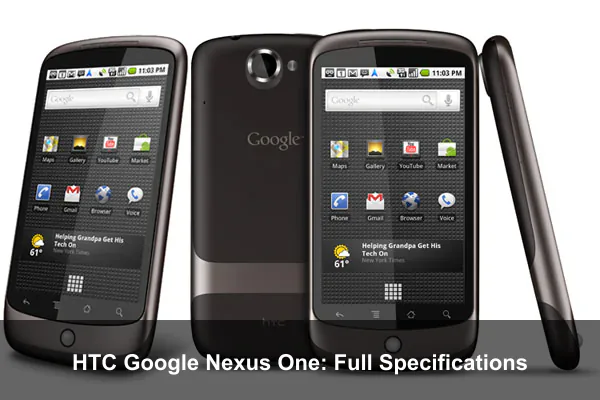
Launched in January 2010, the HTC Google Nexus One was Google’s first flagship-style Nexus phone, built to showcase a clean Android experience. It is now discontinued, but it remains relevant as a milestone device for Android enthusiasts and collectors.
This article focuses on practical value rather than repeating a specs table: what the Nexus One still does well, where it clearly shows its age, and who can still enjoy it today.
Full Specifications
Network
| Technology |
GSM / HSPA |
| 2G bands |
GSM 850 / 900 / 1800 / 1900 |
| 3G bands |
HSDPA 900 / 1700 / 2100 |
|
HSDPA 850 / 1900 / 2100 – for AT&T, Rogers Wireless |
| Speed |
HSPA 7.2/2 Mbps |
Launch
| Announced |
2010, January. Released 2010, January |
| Status |
Discontinued |
Body
| Dimensions |
119 x 59.8 x 11.5 mm (4.69 x 2.35 x 0.45 in) |
| Weight |
130 g (4.59 oz) |
| SIM |
Mini-SIM |
|
Trackball |
Display
| Type |
AMOLED |
| Size |
3.7 inches, 39.0 cm2 (~54.8% screen-to-body ratio) |
| Resolution |
480 x 800 pixels, 5:3 ratio (~252 ppi density) |
Platform
| OS |
Android 2.1 (Eclair), upgradable to 2.3.6 (Gingerbread) |
| Chipset |
Qualcomm QSD8250 Snapdragon S1 |
| CPU |
1.0 GHz Scorpion |
| GPU |
Adreno 200 |
Memory
| Card slot |
microSDHC (dedicated slot), 4 GB included |
| Internal |
512MB RAM, 512MB |
Main Camera
| Single |
5 MP, AF |
| Features |
LED flash |
| Video |
480p@24fps |
Selfie camera
Sound
| Loudspeaker |
Yes |
| 3.5mm jack |
Yes |
Comms
| WLAN |
Wi-Fi 802.11 a/b/g |
| Bluetooth |
2.1, A2DP |
| Positioning |
GPS, A-GPS |
| Radio |
Factory locked by default, can be enabled |
| USB |
microUSB 2.0 |
Features
| Sensors |
Accelerometer, proximity, compass |
| Browser |
HTML |
|
Dedicated search key MP3/eAAC+/WAV player MP4/H.264 player Voice memo Predictive text input |
Battery
| Type |
Removable Li-Ion 1400 mAh battery |
| Stand-by |
Up to 290 h (2G) / Up to 250 h (3G) |
| Talk time |
Up to 10 hours (2G) / Up to 7 hours (3G) |
| Music play |
Up to 20 hours |
Misc
| Colors |
Brown (teflon coating) |
| SAR |
0.37 W/kg (head) 0.74 W/kg (body) |
| Price |
About 120 EUR |
Our Tests
| Camera |
Photo |
| Loudspeaker |
Voice 69dB / Noise 66dB / Ring 79dB |
| Audio quality |
Noise -86.1dB / Crosstalk -85.2dB |
Price and Availability
The HTC Google Nexus One offers a compelling combination of features and performance. While the base price is around €120, the actual cost may vary depending on your location and retailer. Below, you’ll find the approximate price of the HTC Google Nexus One converted into various currencies. Please note that these are estimates based on recent exchange rates as of March 29, 2026 and may not reflect the exact price you’ll find at a retailer.
- United States: $138
- Japan: ¥22,122
- United Kingdom: £104
- Australia: A$201
- Canada: C$192
- Taiwan: NT$4,426
- Denmark: kr895
- Saudi Arabia: ﷼518
- South Korea: ₩208,635
- Germany: €120
- Brazil: R$724
- Vietnam: ₫3.634.622
- Kenya: KSh 17,988
- India: ₹13,080
- Indonesia: Rp 2.343.486
- Nigeria: ₦190,957
- Pakistan: ₨38,699
- Philippines: ₱8,366
- Bangladesh: ৳১৬,৯৭৭
Value in 2026: Budget Icon, Not a Daily Driver
At about 120 EUR in source pricing, the Nexus One sits in collector and nostalgia territory rather than practical smartphone value. Compared with modern low-cost phones, you are paying for historical significance, stock-Android heritage, and replaceable hardware, not current performance or long-term app support.
Design and Build: Compact and Distinctive
The curved body and 130 g weight still feel genuinely compact next to today’s large phones. Details like the trackball, Mini-SIM format, and brown teflon-coated finish give it a character that modern slab designs rarely offer.
Display: Early AMOLED Character
The 3.7-inch AMOLED screen was a highlight in its era and still delivers pleasing contrast for basic viewing. By current standards, resolution and screen coverage are limited, so text and media look less sharp than on even entry-level 2026 devices.
Performance: Snapdragon S1 for Light Tasks
The 1.0 GHz Scorpion CPU, Adreno 200 GPU, and 512MB RAM are suitable for classic Android workflows and lightweight offline use. Multitasking, heavy browsing, and modern apps quickly expose the hardware gap versus current budget chipsets.
Camera: Functional, But Strictly Legacy
The 5 MP autofocus rear camera with LED flash can still capture usable reference shots in good lighting. Video is limited to 480p at 24fps and there is no selfie camera, so imaging is clearly behind modern expectations.
Battery: Removable Convenience Matters
The removable 1400 mAh battery is small by today’s standards, but swapability is a real advantage for long-term ownership and restoration. Rated endurance was solid for its time, though present-day results depend heavily on battery condition and network usage.
Software: Pure Early Android Experience
Android 2.1, upgradable to 2.3.6, gives the Nexus One its strongest identity as a clean, historical Android reference point. The trade-off is major compatibility limits with current apps and services, making it impractical for mainstream daily use.
Connectivity: 3G-Era Essentials Only
Connectivity covers legacy basics with GSM/HSPA, Wi-Fi a/b/g, Bluetooth 2.1, GPS/A-GPS, and microUSB 2.0. Lack of 4G/5G and newer wireless standards is the biggest limitation if you plan to use it beyond hobby scenarios.
Who Should Buy HTC Google Nexus One
This phone makes the most sense for collectors, Android historians, and users building a retro tech setup. If you need dependable modern messaging, banking apps, camera quality, and ongoing software support, a current entry-level smartphone is the better purchase.
Conclusion
HTC Google Nexus One remains an important Android landmark with a compact design and classic software feel, but it is best recommended as a collectible or secondary retro device, not a modern primary phone.